PRODUCT · 3D · FABRICATION
Artificial World
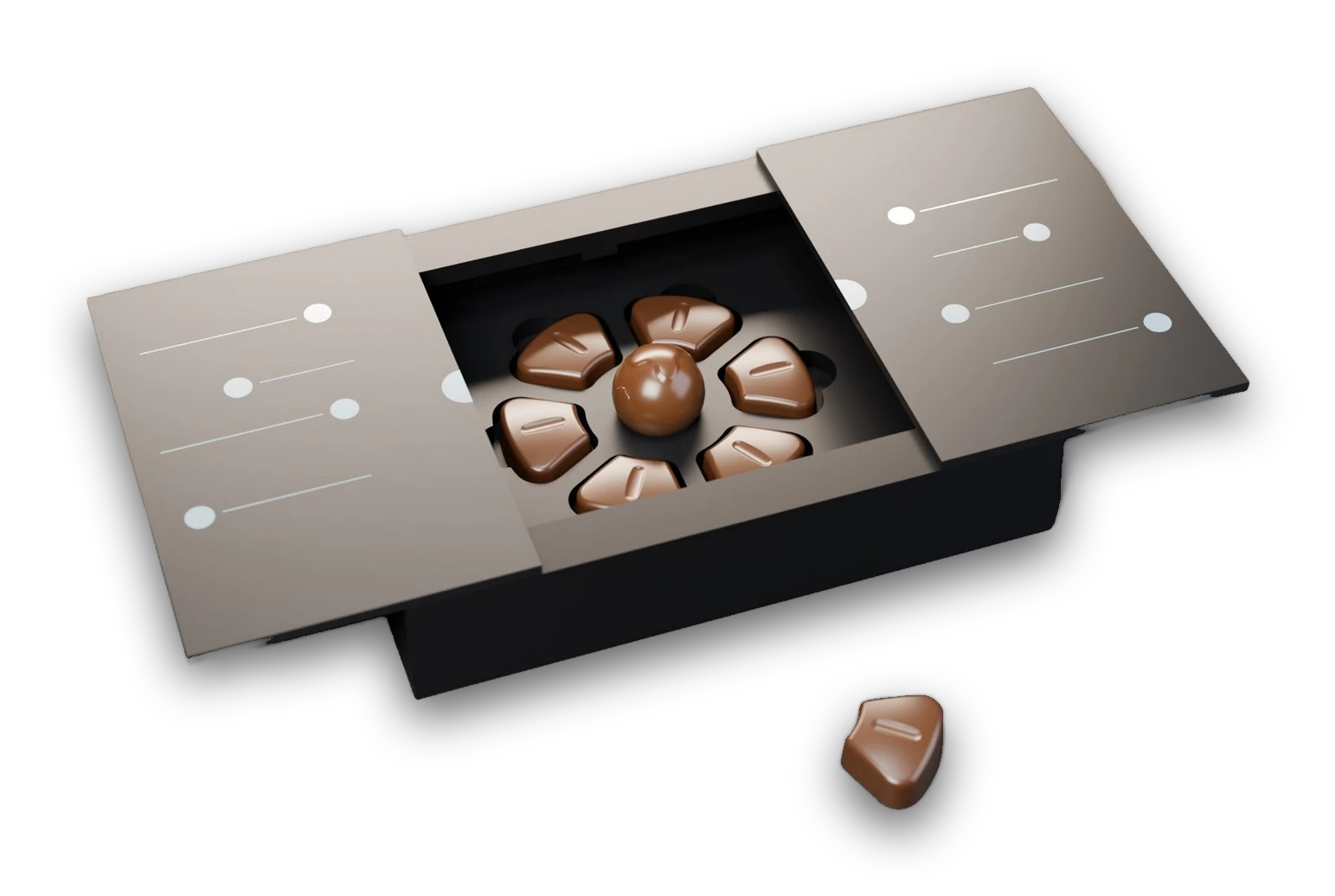
A flower-shaped chocolate with an Earth at its centre, protected by a laser-cut case with twin sliding lids.
Scroll to playCHAPTER 00
Overview
Artificial World imagines a future where natural life has become scarce, and reverses today's relationship: instead of nature being used to advance technology, technology is used to protect nature. The product is framed as something sent back to the present as a warning.
Technology that protects nature. Not the other way around.
- Role
- Solo: concept, CAD, fabrication and rendering
- Course
- DECO2018 Physical Prototyping
- When
- Semester 2, 2026
- Tools
- Autodesk Fusion · Rhino · Blender · laser cutter · 3D printer
CHAPTER 01
Concept
Of three concepts (Time Capsule, Artificial World, Memory of Nature), I developed Artificial World because it had the strongest visual communication and storytelling. Feedback was to keep styling minimal and make the chocolate look edible: my neon, iridescent flower read more like jewellery than food.
CHAPTER 02
Laser cutting the case
I modelled the case in Autodesk Fusion with finger joints and laid out the cut in Rhino: two mirrored lids on L-shaped runners beneath fixed rails, each travelling 55 mm. Following feedback, the flower went from seven petals to six bite-sized pieces in a hexagon, with 6 mm-deep pockets and a 21 mm Earth seat. Pulling the lids apart feels like a two-finger zoom into the Earth.
CHAPTER 03
3D printing the chocolate
Every piece was modelled in Fusion from the laser-cut pocket outlines, offset 1.5 mm for breathing room. A full sphere can't release from a vacuum-formed sheet, so the Earth was split into two halves. Eight PLA masters became a vacuum-formed mould, then plaster casts.
In the workshop, from print to cast:
CHAPTER 04
The unboxing
Rest a hand on each lid and pull outwards: the lids glide apart and the chocolate Earth appears at the centre, ringed by six petals locked into a hexagon.
CHAPTER 05
Final render & poster
I returned to Blender with my final Fusion models for the product render and poster, so one consistent product carries across every output.
CHAPTER 06
Self-critique
Two imperfections I'd fix next time:
- 1 A visible seam on the Earth The two halves were centred by eye and glued, leaving an uneven line on the focal piece. Fix: add a locating peg and hole in Fusion, then fill with plaster slurry and sand flush.
- 2 Plaster flash on the edges A thin fin formed where casts met the trim skirt. Fix: steepen the parametric skirt angle and pour each cavity separately.
END OF BUILD